




If you are starting from zero, begin with Arabic letters and their sounds, then learn how those letters connect, add the basic vowel marks and begin reading short combinations aloud to somebody who can correct you. Tajweed should come in layers while your reading develops; you do not need to memorize every rule before you begin.
If you are an adult who still has to stop and think before recognising an Arabic letter, the first feeling is sometimes embarrassment rather than excitement.
You may have children who read more comfortably than you do. You may have listened to Quran recitation for years while quietly thinking, “I really should have learned this properly by now.”
That feeling is more common than people admit. It is also a poor reason to delay starting again.
In an authentic hadith narrated by ‘Aishah, the Prophet ﷺ speaks of the person who recites the Quran while finding it difficult and continuing through that difficulty. The narration gives that struggling reader encouragement rather than shame. You can read the English translation and grading at HadeethEnc.
First, work out what “beginner” means for you
Two people can both say “I cannot read Quran properly” and need completely different first lessons.
One person may not recognise the Arabic alphabet at all. Another knows the letters individually but becomes lost as soon as they join. Someone else can read slowly, but several sounds have been learned incorrectly and now need patient correction.
A useful first lesson therefore should not begin with a long lecture about Tajweed terminology. It should begin with something simpler: what can you read comfortably right now?
- recognising Arabic letters without having to recite the whole alphabet first;
- hearing the difference between similar sounds;
- recognising a letter when its shape changes inside a word;
- Fathah, Kasrah and Dammah;
- Sukoon, Shaddah and Tanween;
- joining letters without guessing;
- moving away from dependence on English transliteration.
If most of that list feels unfamiliar, that is a perfectly reasonable place to start. A structured Quran Foundations program should meet you at that level rather than assume you already know the basics.
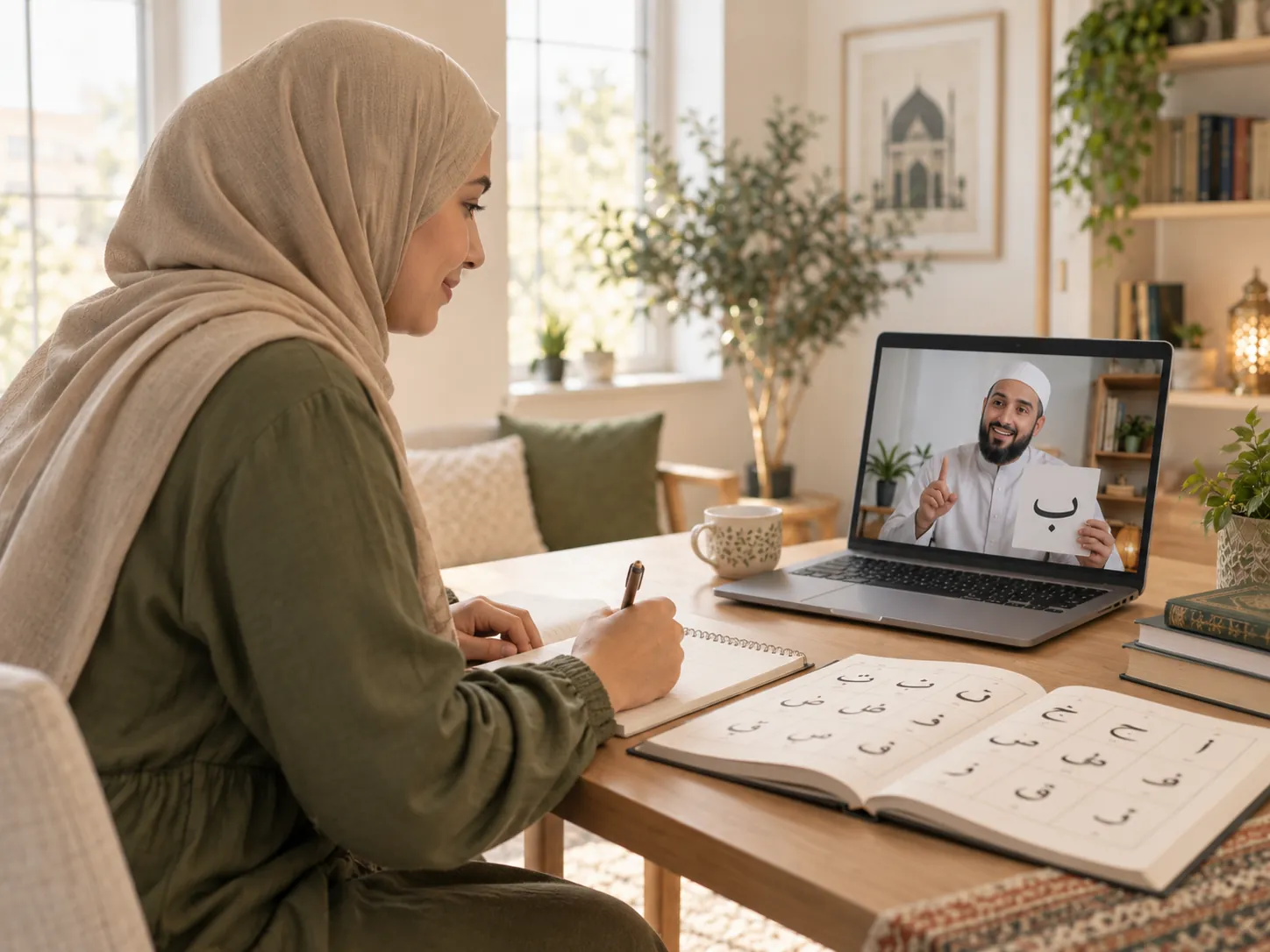
1. Learn the sound with the letter
It is possible to memorise the Arabic alphabet as a sequence and still be unable to read a single word comfortably.
The missing piece is often sound.
When you learn a letter, you are not only memorising a shape. You are training your ear and mouth to recognise and reproduce that sound. Then you begin noticing what happens when the vowel marks are added.
This becomes especially important with Arabic sounds that do not have a neat English equivalent.
A workbook can show you a letter. A teacher can hear what actually came out of your mouth.
2. Learn how Arabic letters connect before chasing speed
Arabic letters do not keep one fixed shape everywhere inside a word. For a new reader, that can make a line of Arabic look far more complicated than the alphabet chart they first memorised.
Do not rush this part.
Spend enough time reading tiny combinations and short words until connected letters stop feeling like completely new symbols.
If you also want to build broader Arabic reading skills, the Arabic Foundations program can take that foundation beyond Quran reading alone.
3. Do not let transliteration become the thing you actually read
Transliteration is tempting because it allows an English speaker to produce something immediately. But Latin letters cannot represent every Arabic sound accurately.
A learner can easily become attached to an approximation rather than learning to recognise the Arabic itself.
IslamWeb discusses this issue in its answer on reading the Quran through another language or transliteration.
If you depend on transliteration today, there is no need to panic. Just make the goal clear: every week, the Arabic itself should become a little less intimidating and the transliteration a little less necessary.

4. Read aloud to somebody who can actually hear the mistake
Silent practice can help with recognition, but Quran reading is also physical. Your tongue, lips and throat are learning movements that may be unfamiliar.
This is why someone can repeat the same mistake for months without realising it.
IslamWeb’s discussion of learning the rules of Quran recitation emphasises oral learning and taking recitation from teachers.
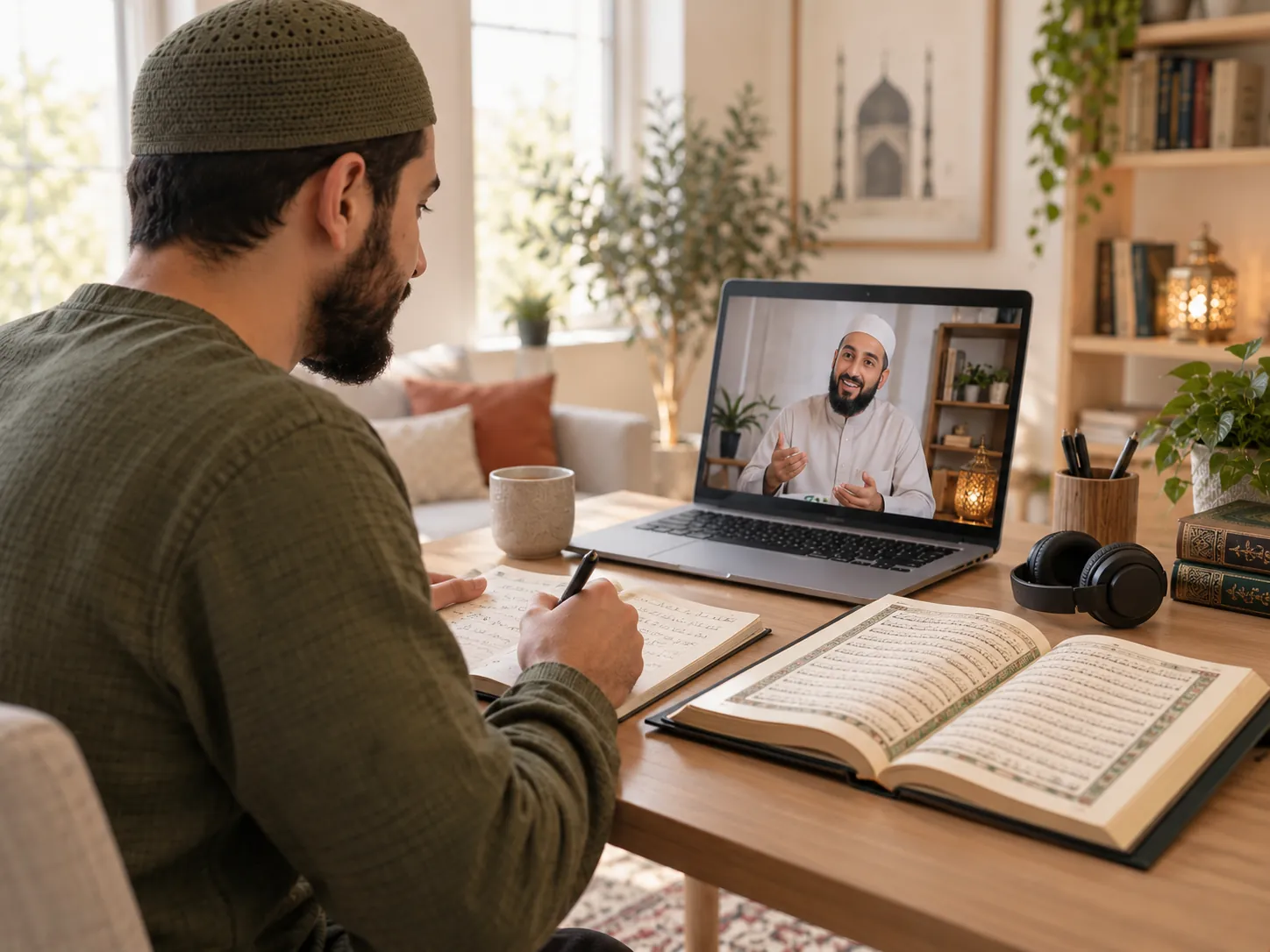
You do not need a teacher who makes you nervous every time you open the Mushaf. You need somebody who can hear one sound, stop at the right moment, demonstrate it again and let you try again without turning every correction into a speech.
Teacher fit matters too. A knowledgeable reciter is not automatically the right teacher for every nervous adult beginner or every young child. Patience and the ability to explain are part of teaching. You can read more about Ayat’s approach to teachers.
5. Tajweed should arrive in layers
A beginner sometimes sees a page full of Tajweed terminology and assumes all of it must be memorised before they are “ready” to read Quran.
That is not a useful way to begin.
Start with accurate letters and basic reading. Then let the rules appear as they become relevant to what you are actually reading. As the reading becomes steadier, more detail can be added.
Allah commands measured recitation in Surah Al-Muzzammil 73:4. You can read the verse and available translations on Quran.com.
For a beginner, slow and deliberate reading is a much healthier target than racing through a page while guessing.
A realistic first eight weeks
This is an example roadmap, not a guarantee. Someone who already recognises the alphabet may move more quickly. Someone correcting long-standing pronunciation habits may deliberately move more slowly.
| Week | Main focus | What progress might look like |
|---|---|---|
| 1 | Letters and sounds | You stop confusing several common letters. |
| 2 | Connected shapes | You begin recognising letters inside short words. |
| 3 | Basic vowels | You can sound out simple combinations. |
| 4 | Sukoon, Shaddah and Tanween | Short words feel less like a puzzle. |
| 5 | Short Quranic phrases | You read aloud and receive direct correction. |
| 6 | Basic articulation and lengthening | You start noticing some mistakes before being told. |
| 7 | Your repeated problem sounds | Practice becomes more specific to you. |
| 8 | Review | You know what the next useful step is instead of guessing. |

What should you practise between lessons?
You do not need to turn every evening into a two-hour study session.
For many beginners, a short routine that genuinely happens is more useful than an ambitious plan that disappears after four days.
A simple practice session might look like this:
- Two minutes reviewing yesterday’s difficult letters.
- Five minutes reading the exact material you covered with your teacher.
- Three minutes repeating the two or three mistakes that were corrected.
- One final slow reading without trying to beat a timer.
The important word is repeat.
Beginners often keep moving to new pages because new material feels like progress. Sometimes the real progress is staying with one difficult sound until you no longer have to fight to produce it.
What should a beginner look for in an online Quran teacher?
Do not choose only by a polished photograph or by whoever has the earliest available time slot.
During a trial lesson, notice what the teacher actually does.
- Do they listen to your current reading before deciding where you should start?
- Can they explain a mistake without making the explanation more confusing than the mistake?
- Do they demonstrate the sound and then allow you to try it?
- Do they notice the same error when it appears again later?
- Will they slow down when you genuinely need another attempt?
- If you are not an Arabic speaker, can they explain enough for you to understand what needs changing?
A trial lesson is useful because “a qualified teacher” and “a teacher who works well with me” are not always exactly the same thing.
What if you are learning Quran as an adult?
Adults often bring one useful advantage to a lesson: they know why they are there.
You may take longer than a young child to change a pronunciation habit, but you can understand explanations, notice patterns and organise your practice around a specific weakness.
For many adults, the bigger obstacles are embarrassment and inconsistency rather than age itself.
If you have spent years saying, “I will start when life becomes quieter,” it may be worth accepting that life may never become perfectly quiet.
Fifteen focused minutes today is more useful than the perfect study plan you keep postponing.
Questions beginners often ask
Can I learn Quran online if I know no Arabic?
Yes. A true beginner can start with Arabic letter recognition, pronunciation and basic vowel marks before moving into connected Quran reading.
Should I learn Arabic or Tajweed first?
If the immediate goal is Quran reading, begin with the Arabic reading skills needed to recognise and pronounce the text while essential Tajweed points are introduced gradually.
How long will it take me to read Quran fluently?
There is no honest universal number. Starting level, lesson frequency, pronunciation habits, practice and consistency all affect the answer.
Is one lesson a week enough?
It can be a starting point, but a beginner still needs short, regular practice between lessons. Reading improves through repeated use and correction.
Sources & further reading
You do not need to know your level before you start.
A trial lesson lets a teacher hear your reading, identify the first skills that need attention and suggest a sensible place to begin.