

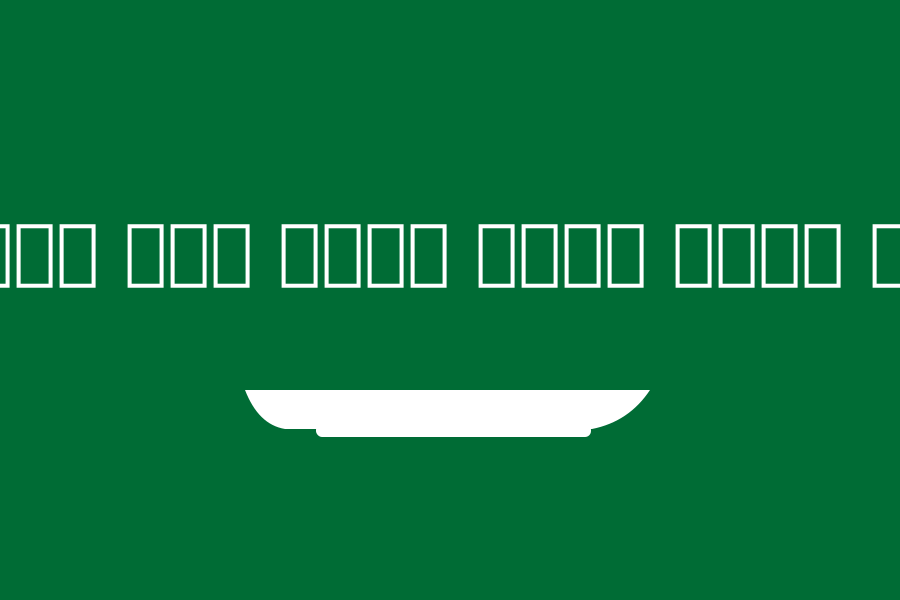


Qalqalah is the brief audible release that appears when one of five specific letters—ق ط ب ج د—is sakin. The sound should keep the identity of the consonant. It is not permission to add “a,” “i” or “u” after it.
Beginners often understand Qalqalah intellectually and still produce it as an extra vowel. That happens because a completely closed consonant can feel difficult to release.
The useful question is: can the listener hear the letter clearly while still hearing that it has no vowel?
What Qalqalah is
The word is often translated with ideas such as vibration, bounce or echo. Those translations are helpful only if they lead to the right sound. In practice, the articulation is held and then released so the sakin letter remains audible.
Do not shake the jaw or manufacture a dramatic echo. The effect comes from the consonant’s articulation, not from adding a second syllable.

The five Qalqalah letters
The letters are ق ط ب ج د, memorized by many students as قطب جد. Learn the group, but also learn each letter independently because their articulation points are different.
A clear ق with Qalqalah still needs a correct ق. If it has already drifted toward ك, the bounce will not fix the letter.

When Qalqalah happens
The condition is sukun. Sometimes the letter already carries a sukun inside connected reading. At other times, stopping at the end of a word creates a temporary sukun and the Qalqalah becomes more noticeable.
This is why learners may hear a stronger effect at a stop than in the middle of a phrase.

How it should sound
Release the letter cleanly without attaching a full vowel. If بْ becomes “ba,” or دْ becomes “da,” you have gone too far. If the letter disappears completely, you have not released it enough.
A teacher can help you find the narrow middle ground where the consonant is audible but remains sakin.

Why teachers mention levels
Many beginner programs describe a lighter Qalqalah in connected reading and a stronger one when stopping on the Qalqalah letter. Some Tajweed curricula divide the effect into more detailed levels.
Do not let the naming system distract you from the first goal: recognize the sakin letter and release it without inventing a vowel.
A simple practice method
Practise each of the five letters with sukun after a comfortable vowel, then use short Quranic examples. Alternate a clean sakin consonant with an intentionally wrong added vowel so your ear learns the contrast.
Record three repetitions. If every attempt sounds like a separate syllable, reduce the bounce. If the consonant vanishes, give the release slightly more clarity.
The broader Quranic instruction for measured recitation appears in 73:4 on Quran.com. For discussion of learning Tajweed rules, see IslamWeb.
Qalqalah is easier when you stop trying to “make an echo” and instead learn to release a sakin consonant clearly.